Vessel colorless glass fragment (Archaeological Find)

Title:
Vessel colorless glass fragment
Subject:
This small clear glass tube is composed of scientific instrument glass and is cylindrical, with a broken end and a more rounded end. Emily and I excavated it in the first level of H987, a mixed dirt layer consisting of artifacts from different time periods. Its depth is 18-30 cmbd. The original artifact may have been part of Harvard’s collection of scientific instruments in the 1700s, although it is difficult to tell since it could have been redeposited from another area in the Yard. Fragments of scientific instruments remind one of figures such as John Winthrop, the Professor of Natural Philosophy at Harvard (depicted in Figure 2), who would have used beakers and other instruments to demonstrate natural experiments. Harvard also had a philosophy chamber (1766-1820) that housed scientific instruments. Built after the devastating fire of the original Harvard Hall, this collection included glassware and scientific instruments that were mostly from England, and the lectures and debate that took place there helped root Enlightenment thought in American society (Harvard Art Museums 2017). Harvard’s curriculum underwent a radical change from an emphasis on biblical studies to a focus on science and the humanities, and that change is evident in material remains. Harvard’s curriculum began incorporating more science teachings in the 17th and 18th centuries. A notebook from John Holyoke (A.B. 1662) contains notes related to texts on logic, physics, and metaphysics (Knoles 2002). John Holyoke wrote notes on Nehemiah Ambrose's synopses of logic and physics (Figure 3). A focus on empiricism was important in Harvard in the wake of the Enlightenment, which began in the second half of the 1600s.
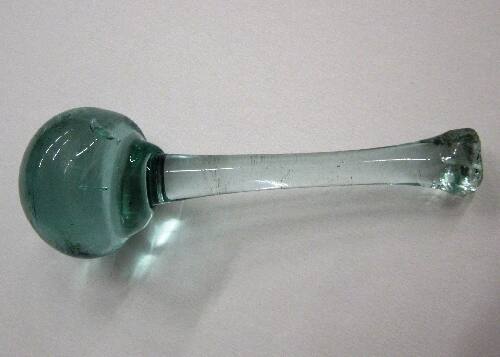
This artifact shows many qualities that could relate it to old glass scientific instruments from the 1700s. That this glass is uneven, does not have visible mold seams, and has variation in thickness is an indication that it is handmade and not factory produced. This glass fragment is similar to Figure 4, a glass pestle in the collection of the Corning Museum of Glass from the late 18th century. Although the fragment likely wasn’t a pestle, it has a similar color and glass thickness in the tube. This pestle was made in England, and Harvard at this time likely would have been sourcing its glass instruments from England since the United States did not have established glass producers. This fragment may have been part of a scientific apparatus such as a glass tube that would have been used in laboratory experiments related to air pressure, liquids, and chemical reactions. In the eighteenth century, professors at Harvard demonstrated natural reactions using imported scientific instruments. This glass tube could have been used in an early physics or chemistry lecture at Harvard. It provides an example of material culture of Harvard’s scientific curriculum which relates to the broader intellectual shift from a focus on religiosity to a focus on empiricism in college curriculums in the United States.
Object Name:
Vessel colorless glass fragment
Inventory Description:
Vessel colorless glass fragment
Peabody Number:
2025.8.74
Intrasite:
H987 level 1
Depth:
18-30 cmbd
Class 1:
Glass
Class 2:
Vessel glass
Class 3:
Colorless vessel glass
Quantity:
1
Height (cm):
3.5
Width (cm):
1.3
Depth/Thickness (cm):
.4