Red Clay Pipe Bowl (Archaeological Find)
Files
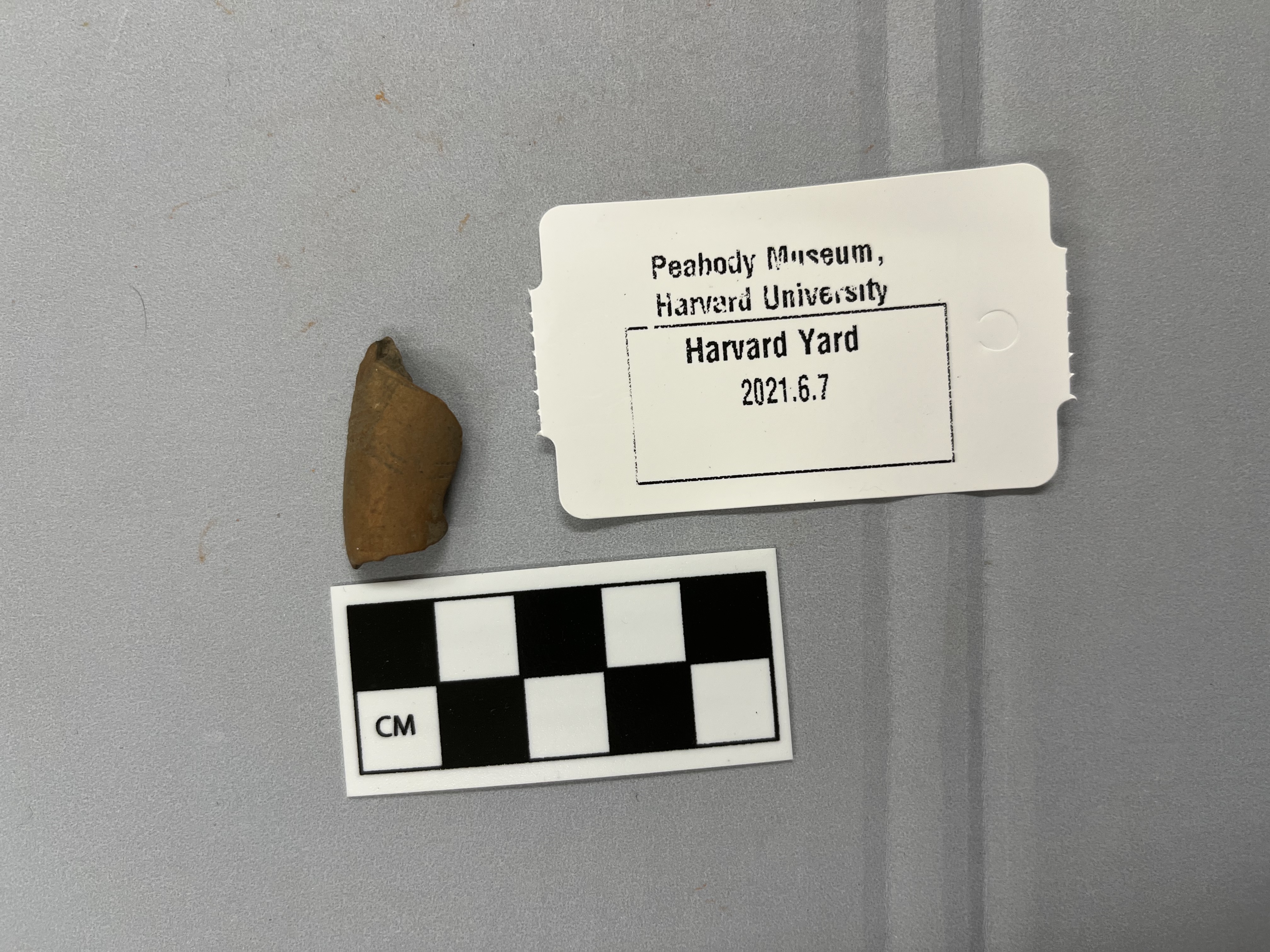
Title:
Red Clay Pipe Bowl
Object Name:
Red Clay Pipe Bowl
Inventory Description:
Friday, November 5, 2021, started like any other day. I arrived at the Harvard Yard site, Clover Coffee in hand, ready to dig.
“God,” I said, like I say each day, indiscriminately, “where is my red clay pipe stem?”
“You have a red clay pipe stem?!” Trish asked with excitement.
“No, no, just hoping to find one.”
I had prayed and hoped and wished for a pipe stem after the units near me started finding them, and lo and behold, they started coming out of the ground at H968. But then I learned that out there existed red clay pipe stems: like white clay pipe stems, but cooler and also they’re red. To find a red clay pipe stem would be exquisite.
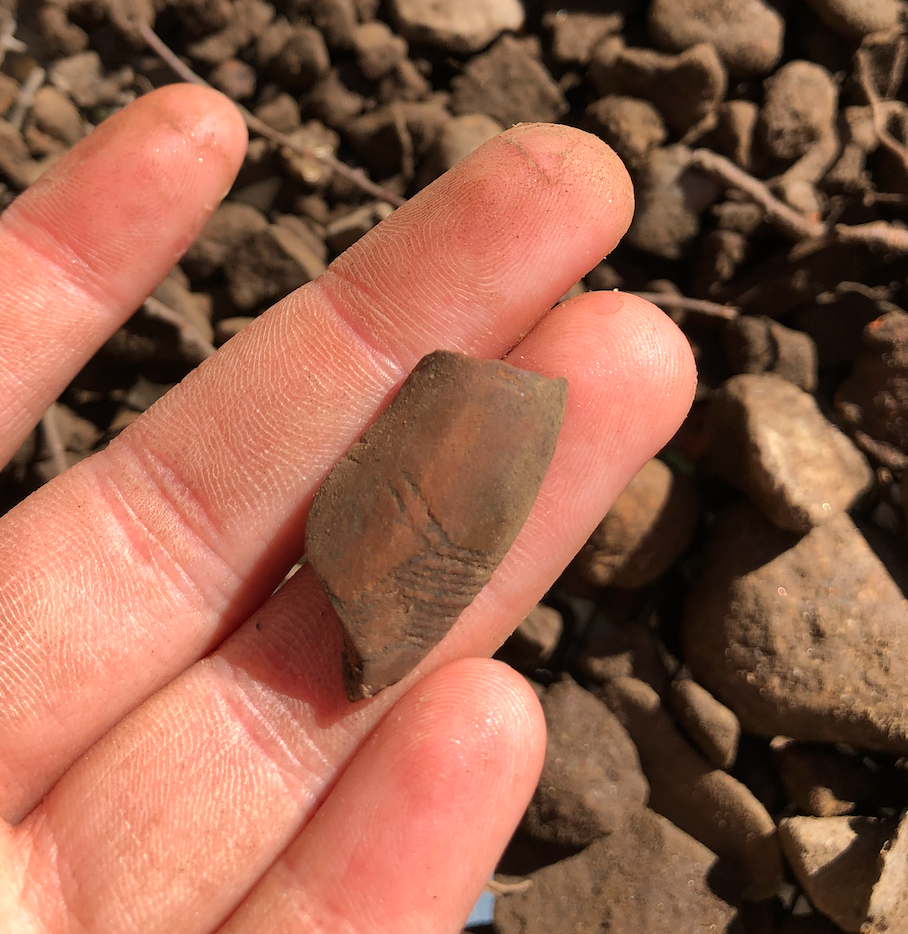
And then, like God appearing to Jacob in a dream, an inch-ish long piece of ceramic appeared in the screen. At first, I assumed because it was red and ceramic that it was probably a brick fragment — but the archaeology gods had different plans for me. Alas, there it was: not just a red clay pipe STEM, but a red clay pipe BOWL, with markings, too.
In the excitement of the moment, I lost track of time and missed the bus I was supposed to take that afternoon to Cape Cod. As I sat in South Station waiting for the next bus, I started to investigate the origins of find. Did it come from Cambridge? From the Chesapeake region? From the kingdom of Heaven itself?
On first glance, it seems likely that the pipe came from a local craftsman. Petrographic analysis shows that red clay pipes found in New England are often indeed made in New England (Capone and Downs). But, I was struck by the zig-zag rouletting around the face of the bowl. After some research on Chesapeake area red clay pipes, I’d like to venture a very specific origin: the Nomini Plantation in Westmoreland County, Virginia.
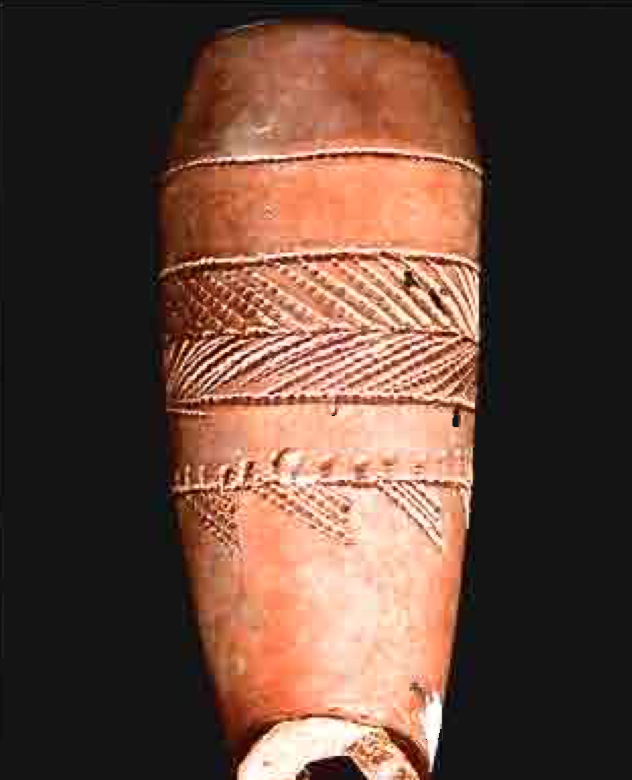
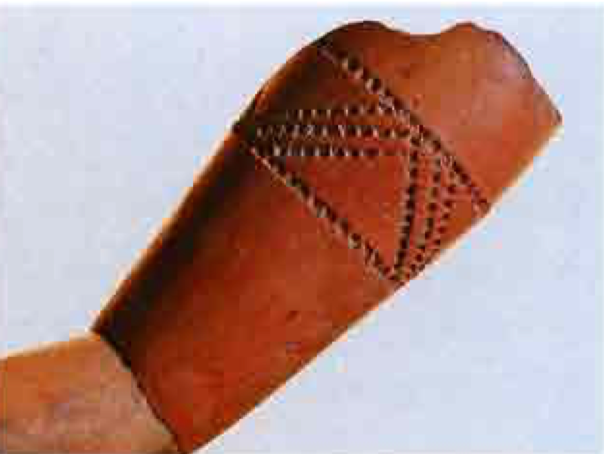
In looking at and reading about red clay pipes from the Chesapeake region, I saw striking similarities in artifacts from the Nomini plantation. From Lukenbach and Kiser: “Banded bowls have a rouletted band around the center of the bowl — in some cases simply two parallel lines, in others the two parallel lines enclose a wider band of diagonal rouletting.” Above, see two examples from the Nomini Plantation next to my pipe bowl. Similar, no? Nomini pipes are also characterized by their unusually thin bodies, which mine has too. Its thickness, from the bottom of the curve to where the bowl breaks off, is only 0.6 cm. The thickness of the clay could not be more than 0.3 cm.
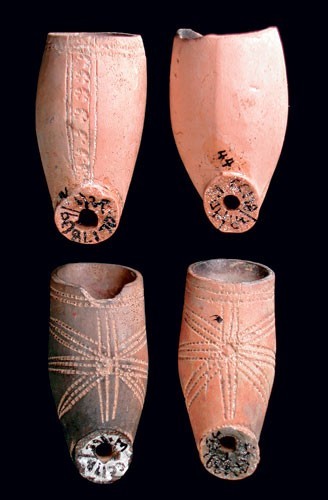
Furthermore, red clay pipes by Algonquin craftsmen from the Chesapeake region have similar markings to those found at the Nomini Plantation and in my unit. See: https://chipstone.org/images.php/294/Ceramics-in-America-2006/Seventeenth-Century-Tobacco-Pipe-Manufacturing-in-the-Chesapeake-Region:-A-Preliminary-Delineation-of-Makers-and-Their-Styles , https://explore.lib.virginia.edu/exhibits/show/layersofthepast/multiplenarratives/locally_made_pipes
“Al Luckenbach and Taft Kiser Seventeenth-Century Tobacco Pipe Manufacturing in the Chesapeake Region: A Preliminary Delineation of Makers and Their Styles.” Chipstone, https://chipstone.org/images.php/294/Ceramics-in-America-2006/Seventeenth-Century-Tobacco-Pipe-Manufacturing-in-the-Chesapeake-Region:-A-Preliminary-Delineation-of-Makers-and-Their-Styles.
Source shows different Chesapeake area colonial red clay pipes.
Capone, Patricia & Elinor Downes. 2004. “Red Clay Tobacco Pipes: Petrographic Window into Seventeenth Century Economics at Jamestown, Virginia and New England.” In S. Lafferty & R. Mann (Eds). Smoking and Culture: The Archaeology of Tobacco Pipes in Eastern North America. “ Univ. of Tennessee Press.
Source uses petrographic analysis to derive the origins of red clay pipes throughout the east coast.
Jones, Brian. “Hollister Site Artifacts.” Office of State Archaeology, 28 Dec. 2017, https://osa.uconn.edu/home/recent/hollister/hollister-site-artifacts/#.
Source shows a number of artifacts found in Wethersfield, CT.
“University of Virginia Library Online Exhibits: Layers of the Past: Discoveries at Flowerdew Hundred.” Omeka RSS, https://explore.lib.virginia.edu/exhibits/show/layersofthepast/multiplenarratives/locally_made_pipes.
Source shows images of red clay pipes from Virginia.
Peabody Number:
2021.6.7
Intrasite:
H968, Level 7
Depth:
60 cm
Class 1:
Ceramic
Class 2:
Pipe bowl
Quantity:
1
Height (cm):
2.8 cm
Width (cm):
1.5 cm
Depth/Thickness (cm):
.6 cm